
Your fence ownership isn’t obvious from just looking at it—I learned this the hard way after assuming my neighbor owned ours. Check your title deeds for a “T” mark pointing toward your side; that’s your ownership signal. If deeds are vague, the Land Registry has your answers online. The finished fence face usually faces the owner’s property, but that’s just a clue, not proof. Getting it right matters because ownership determines who pays for repairs, and nobody wants surprise bills.
How Property Lines Determine Ownership
Ever wonder whose fence is actually yours? I did too, until I learned how property lines truly work.
Ever wonder whose fence is actually yours? I did too, until I learned how property lines truly work.
Your title deeds and Land Registry are your first clues. I found that boundary plans clearly mark ownership direction with a simple “T”—it points toward whoever owns the fence. Pretty neat, right?
Here’s what helped me understand: the property line is the invisible boundary between your land and your neighbor’s. Fences usually sit just inside the owner’s side, making responsibility obvious.
When I wasn’t sure, I consulted a surveyor. That guidance clarified everything. They can confirm your exact boundary and resolve confusion between neighbors.
Don’t stress if your documents seem unclear. A boundary search or professional surveyor guidance removes the guesswork. You’re not alone in this confusion—most of us scratch our heads initially. Once you know your boundary, everything clicks into place.
Does Fence Orientation Show Ownership?

I’ve stood in my backyard staring at fence panels more times than I’d like to admit, convinced the “good side” facing my neighbor’s yard meant something definitive about who actually owned it—spoiler alert, it doesn’t. You’ll notice visual clues like which side shows the finished face versus the raw posts and rails, and where the structural framework sits, but honestly, these details are more like breadcrumbs than a property deed. The real answer lives in your title documents, Land Registry plans, or a professional survey, which will show you a “T” mark (fence belongs to one side) or “H” mark (you’re sharing responsibility), so don’t trust orientation alone to settle the question.
Visual Clues And Indicators
How can you tell whose side of the fence is actually yours just by looking at it? I’ll be honest—I’ve stood in my backyard more than once, squinting at my fence like it’d suddenly reveal its secrets. Here’s what I’ve learned: check which side shows finished surfaces versus raw framework. The polished side usually faces the owner. You’ll also notice fence frames often lean toward the owner’s property, suggesting the boundary runs along the opposite edge. But here’s my confession: appearance alone fooled me twice. That’s why I now verify everything using title deeds and Land Registry plans. These official documents show boundary ownership markers and maintenance responsibilities, giving you actual proof rather than guesses.
Structural Framework Placement Patterns
Looking past the surface of your fence tells you something important about who actually owns it. I’ve learned that fence orientation matters more than most folks realize. Traditionally, the finished “good side” faces inward—toward the owner’s property—while posts and rails show outward. It’s like putting your best furniture facing your own living room, right?
However, modern fences often use double-sided designs that look polished on both sides, making orientation trickier to read. That’s where boundary plans and title deeds become your best friends. They’ll show exactly where ownership sits relative to the property line.
If you’re still confused, a professional survey removes all doubt. I’d rather spend a little money there than argue with neighbors later. Trust me on this one.
Documentation Verification Requirements
When you’re standing in your yard staring at that fence, can you actually prove who owns it just by looking? I couldn’t either, honestly. That’s where your title deeds come in handy. I checked mine and found a “T” mark on the boundary plans—turns out that little symbol means I own that side. If your title documents don’t spell it out clearly, don’t panic. The Land Registry has your back. You can look up your property’s boundary plans online, though there’s usually a small fee. That “T” mark versus an “H” (which means shared ownership) makes all the difference for ownership confirmation. Getting your verification records straight now saves headaches later. Trust me, it’s worth the effort.
Finding the T Mark: Reading Your Title Deeds for Ownership
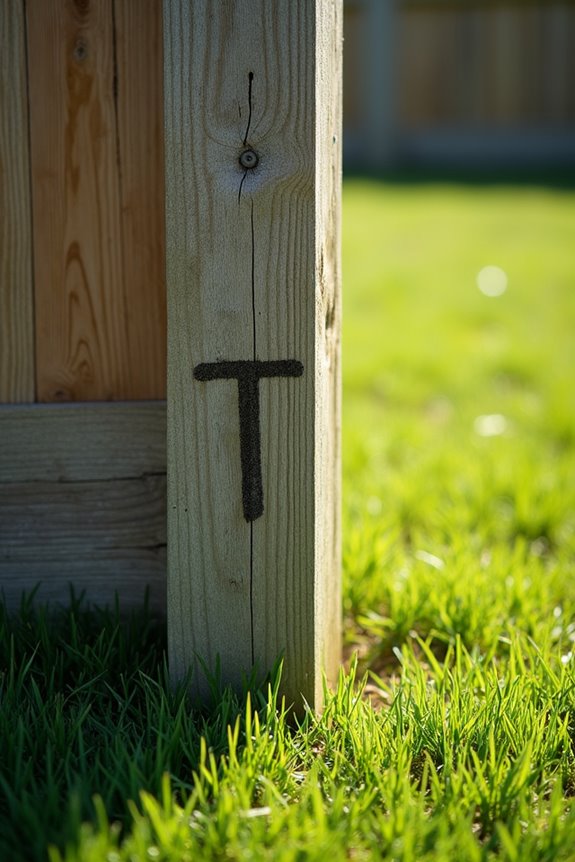
When I first looked at my title deeds, I honestly had no clue what that little “T” symbol meant—turns out it’s the key to understanding who owns what fence. You’ll want to locate the “T” mark on your boundary plan since it points toward the side owned by your property, and if you’re seeing an “H” (which is really just two Ts joined together), that means you’re sharing the fence maintenance duties with your neighbor. If your deeds don’t show the boundary clearly, don’t stress; you can grab an official Land Registry plan online for a small fee and get the straight answer about which side is actually yours.
Locating The T Mark
How do you actually find that mysterious “T” mark everyone keeps mentioning? I’ll be honest—I spent weeks staring at my boundary plans before spotting mine. You’re looking at official documents from the Land Registry or your title deeds. The “T” appears as a small line perpendicular to your property line. The stem points toward whoever owns that fence side.
| Mark Type | What It Means | Your Responsibility |
|---|---|---|
| Single T | You own it solely | Full maintenance |
| Joined Ts (H) | Shared boundary | Split costs equally |
| No T | Unclear ownership | Check with registry |
| Multiple Ts | Complex situation | Consult a surveyor |
Start by requesting copies from Land Registry online. There’s usually a small fee. Once you have those plans in hand, grab a magnifying glass if needed. That little “T” tells you everything about who’s responsible for what.
Interpreting Boundary Symbols
What does that tiny perpendicular line actually mean for your wallet and your weekend chores? That’s the T mark on your boundary plan, and it’s basically your property’s legal instruction manual. When I first discovered mine, I realized it showed exactly which side of the fence belonged to me. The H mark—basically two joined Ts—indicates a party fence, meaning you’re sharing both ownership and maintenance responsibilities with your neighbor. I’d recommend checking your title deeds first, though honestly, they’re sometimes vague. Your Land Registry plans are clearer and worth the small search fee. Think of these symbols as your boundary ownership roadmap. They tell you what’s yours to maintain, saving you from awkward fence disputes later.
Verifying Official Documentation
Once you’ve spotted those T and H marks on your boundary plan, the real detective work begins—finding your official documentation to confirm what’s actually yours. I’ll be honest—I almost relied on a neighbor’s word about our fence ownership until I checked the Land Registry. That’s when everything clicked into place.
Your title deeds contain essential boundary ownership details, though they’re not always crystal clear. If you’re missing deeds copies, don’t panic. You can access official Land Registry records online for a modest fee. This plan verification beats guessing every time. Pull up those T marks against your official records and compare carefully. The T points toward the fence-owning property, while H indicates shared responsibility. Trust the government sources over informal “rules”—they’ve got your back.
UK Regulations: Who’s Responsible for Maintenance?
Confusion about fence responsibility is something I see come up constantly, and honestly, it stumped me too when I first checked my own property deed. In England and Wales, boundary ownership isn’t always crystal clear on title deeds. That’s where the “T” mark comes in—it shows which side handles maintenance responsibilities. If you’ve got a shared boundary, you’ll see an “H” mark instead, meaning you and your neighbor share the load.
| Boundary Mark | Meaning | Your Role |
|---|---|---|
| T | Single ownership | You maintain |
| H | Shared boundary | Negotiate duties |
| Missing info | Unclear | Check Land Registry |
| Formal agreement | Documented | Follow agreement |
| Dispute exists | Contested | Consult solicitor |
Getting clarity from your boundary plans and Land Registry records takes the guesswork out. A boundary agreement formalizes everything, protecting both you and your neighbor.
When Your Documents Don’t Show Ownership
Here’s the thing—you’ve pulled out your title deeds, scrolled through them twice, maybe three times, and there’s still no mention of who owns that fence between your property and your neighbor’s.
Don’t worry. You’re not alone in this confusion. Here’s what you can do:
- Check Land Registry plans online for a “T” boundary (you own it) or “H” boundary (shared responsibility)
- Access official boundary ownership details through the Land Registry website for a small fee
- Look for the T marking on your side of the fence—that’s your maintenance responsibility
When title deeds stay silent on boundary ownership, the Land Registry plans become your best friend. That little “T” or “H” tells you everything. Still stuck? Consider drafting a boundary agreement with your neighbor and getting legal advice to make it official and enforceable.
Ownership Disputes: When Documentation Is Missing
What happens when you can’t find any documentation at all—no deeds, no plans, no helpful “T” or “H” marks to guide you?
I’ve been there. It’s stressful. Your best move? Contact the Land Registry online and review their boundary plans directly. Sometimes those records reveal ownership details your deeds missed entirely.
| Step | Action | Cost |
|---|---|---|
| 1 | Check Land Registry plans | Small fee |
| 2 | Look for “T” or “H” marks | Included |
| 3 | Hire a surveyor if unclear | £300–£500+ |
| 4 | Create written boundary agreement | Varies |
| 5 | Formalize with neighbors | Minimal |
If that doesn’t work, consider hiring a surveyor. They’ll locate your actual boundary line and determine party fence responsibilities. You could also draft a boundary agreement with your neighbors—it settles disputes without court drama. We’re in this together.
Managing Repairs on Boundaries You Share

Once you’ve figured out whose side of the fence is actually yours, you’ll face the real test: keeping it in good shape.
Here’s what I’ve learned about managing shared fence repairs:
- Get it in writing: A boundary agreement prevents future headaches and clarifies who pays for what
- Coordinate everything: Discuss timing, materials, and paint treatments with your neighbor before touching anything
- Know your limits: Check your property deeds or consult a surveyor to confirm maintenance responsibility
When direct conversations stall, mediation saves relationships. I’ve seen neighbors avoid years of tension by simply talking through fence ownership decisions together. Your boundary lines determine your legal responsibility, but honest communication determines your friendship. Start the conversation early—your shared fence depends on it.
When to Call a Surveyor or Lawyer

At some point during your fence journey, you’ll probably wonder whether you actually need professional help—and honestly, that’s the moment you should stop wondering and just call someone.
I learned this the hard way. A surveyor confirms your exact boundary lines and whether your fence sits on, inside, or over the line. That’s worth every penny. If disputes pop up about ownership or maintenance responsibilities, a lawyer steps in. They’ll review your deeds and advise on enforceable agreements.
Here’s my confession: calling both professionals early saved me headaches—and money. You’ll avoid tax implications, neighbor conflicts, and HOA violations. Think of them as your fence safety net. When boundary questions arise, you’re not guessing anymore. You’re protected.